For years, marketers have looked to automation as the answer to the growing demand for content. Create enough rules in your workflows and the system can handle the rest. Artificial intelligence is proving that this is not true.
According to Bynder’s “State of DAM Report 2026,” 93% of enterprise organizations face content challenges that existing rules-based automation can’t solve. The biggest problem isn’t publishing content faster. They are taking over off-brand assets, regulating AI-generated content, producing personalized content at scale, and managing increasingly complex workflows.
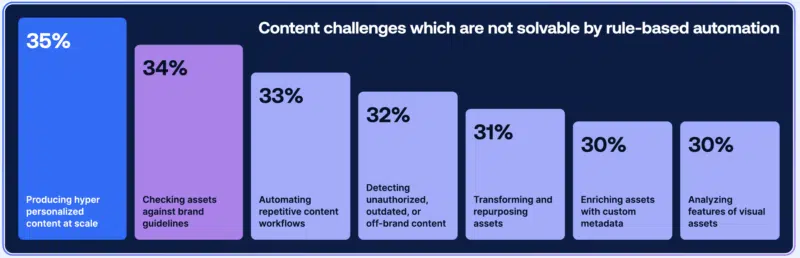
Rule-based automation works well in expected scenarios. However, AI doesn’t do well by following rules. He likes to add things as he goes along, imagining he knows what you “really” want. So marketers went from “Yeah, look at all the content AI can create” to “What did it do this time?”
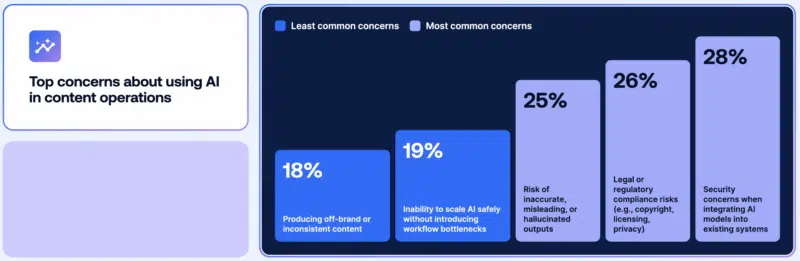
Security is now the top concern for marketers when using AI in content operations, followed by legal and regulatory compliance and inaccurate or biased results. Respondents also cited concerns about inconsistent brand content and scaling the AI without creating new workflow bottlenecks.
These concerns go beyond DAM. Every marketing organization is trying to balance faster content production with copyright compliance, brand governance, privacy requirements and increasing scrutiny of AI-generated content. As AI becomes integrated into marketing operations, governance is becoming part of day-to-day campaign execution rather than a final review phase.
Humans remain responsible for the final decision
Between brand governance, metadata management, content quality, and adapting assets to different channels, the most common workflow combines AI with human approval. About 40% to 44% of respondents said automation does the work while people make the final decision. Another 31% to 35% rely on mixed workflows that combine automation and manual review throughout the entire process.
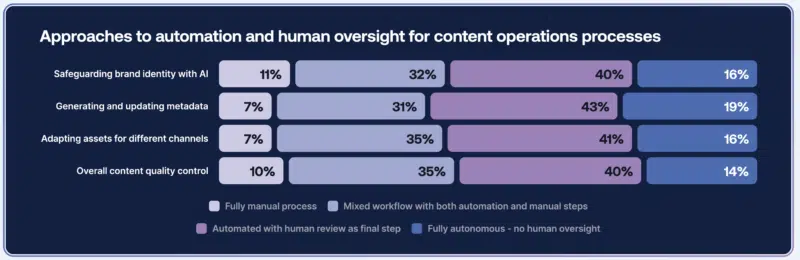
Instead of replacing people, AI is taking the place of repetitive work, allowing marketers to focus on judgment, governance and accountability.
The findings also point to a broader lesson. AI works best when it has access to well-organized content, consistent metadata, clear branding guidelines, and defined approval processes. Without this context, even sophisticated AI has difficulty making reliable decisions.
That’s why many organizations view their DAM platform as the foundation for AI governance. Instead of just storing assets, these systems are becoming the place where AI can access the rules, permissions and context needed to support the creation, review and distribution of content at scale.
Marketing has spent the last two decades automating repetitive tasks. Artificial intelligence is moving the conversation in a different direction. The challenge is no longer how much work can be automated. It’s about deciding where automation should end and human judgment should begin.
Bynder’s “State of the DAM 2026 Report” is available for download here. (Registration required.)
Your customers search everywhere. Make sure your branding introduces himself.
The SEO toolkit you know, plus the AI visibility data you need.
Start your free trial
Start with