Nine in 10 marketers say budget constraints are taking a toll on their paid media programs, but many continue to overlook one of the biggest drivers of performance: what happens after the click. New research from Unbounce and Ascend2 found that marketers consistently invest more time and money in targeting, creative and AI than in the landing pages and post-click experiences that ultimately determine whether paid traffic converts.
The survey of 304 US paid media professionals found a clear disconnect between what marketers believe improves ROI and where they actually invest. While 40% believe that landing page optimization is one of the most effective ways to maximize paid media spend, only 31% have invested in landing pages in the past six months. The budgets instead flowed into audience research (40%), artificial intelligence tools (39%) and advertising creativity (38%).
The findings suggest that budget pressure isn’t simply forcing marketers to spend less. It’s pushing them towards faster, simpler optimizations within advertising platforms, leaving behind more resource-intensive post-click work.
Budget pressure shifts spending upstream
Budget constraints have become almost universal. 90% of marketers reported budget or resource constraints for paid media, with testing and experimentation in the hardest-hit areas. Audience targeting, ad creative and reporting also took a hit, while nearly half said landing page creation or message matching suffered due to reduced resources.

This pattern continued in spending decisions. Audience research, AI tools and advertising creative attracted the largest share of new investment, while landing pages ranked well behind, despite marketers recognizing their importance. The report found that marketers who exceeded their ROI goals invested more evenly in audience research, AI, attribution, testing and landing pages instead of concentrating resources in a few highly visible areas.
Artificial intelligence followed the same pattern. 86% of marketers reported using AI in paid media, and nearly three-quarters said it improved ROI. Most, however, used AI for reporting, audience targeting, platform tools and ad copy. Only 19% used AI to create or optimize landing pages, even though marketers who exceeded their ROI goals were about twice as likely to use AI in those areas.
The clicking is not the problem
Many marketers also compromise their targeting efforts after getting the click.
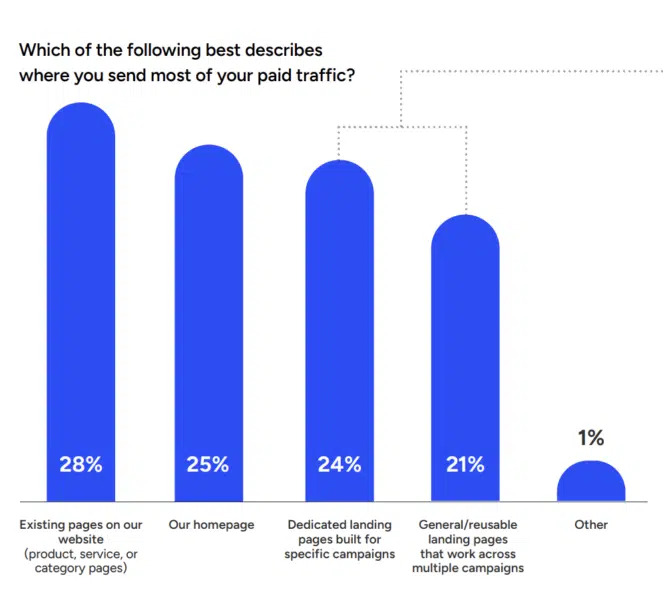
More than half of respondents send paid traffic to general website pages rather than campaign-specific landing pages. 28% direct visitors primarily to existing product or category pages, while another 25% direct them to the home page. Only 24% primarily use dedicated landing pages created for individual campaigns.
The discrepancy becomes more apparent when considering the campaign objectives. 40% of direct sales-focused marketers send traffic to general product or category pages rather than destinations built specifically to drive conversions. More than a quarter of marketers running lead generation campaigns still send prospects to their homepage.
This strategy appears to come at a cost. Nearly two-thirds of marketers who primarily send paid traffic to their homepage said they were not exceeding their ROI goals, while marketers who exceeded their goals were less likely to rely on homepages and more likely to use reusable or campaign-specific landing pages.
Marketers know what works, but they don’t prioritize it
The report found that marketers understand the value of post-click optimization. Audience targeting ranked first as the most effective way to optimize paid media spend, followed by landing page optimization, before cutting underperforming channels, switching platforms or setting spending limits.
Their daily priorities tell a different story.
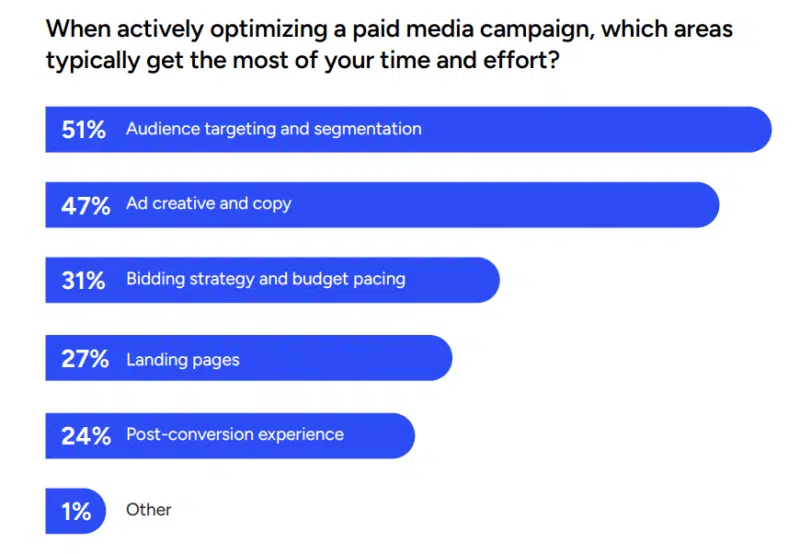
More than half said audience targeting receives the most optimization efforts, followed by ad creative and bidding strategy. Landing pages and post-conversion experience rank low on the list despite being widely regarded as important contributors to ROI.
10x your SEO with Semrush for business.
The most powerful SEO platform in the world, created specifically for businesses.
Request a demonstration
The report emphasizes operational constraints rather than strategic disagreement. Team capacity, design and development resources, skills, maintenance, and software budgets were the biggest obstacles preventing increased use of landing pages. In other words, marketers generally know that the post-click experience is important. They often don’t have the people, time or resources to improve it.
The best performing teams seem to solve this problem by treating paid media as an end-to-end system rather than a series of disjointed optimizations. Throughout the report, marketers who exceeded their ROI goals consistently invested more in landing pages, attribution, testing and post-conversion improvements, along with audience targeting, creative and AI, suggesting that the greatest gains come from strengthening the entire customer journey rather than simply generating more clicks.
The full report can be downloaded here. (Registration required)