Five straight years of record heat, sporadic rain and divided leadership have Corpus Christi in danger of becoming the first U.S. city to run out of water.
Only rain – lots of rain – can save this coastal city from this tragic fate.
Available short-term water sources, including newly drilled wells, have been exploited. A controversial desalination plant with the ability to filter seawater is back on the table after being rejected last year over cost and environmental concerns, but is still years away from being operational. Building a new lake-sized reservoir is another option, but it would take longer.
Corpus Christi is bracing for a situation where demand will outstrip water supplies next summer, leaving too little time to avert the crisis by building new infrastructure, said Kenneth Deese, a Fort Worth water resource engineer.
At this point, he said, “the only thing you can do is stop using water.”
City leaders are looking for ways to delay rather than avoid the looming emergency through protective measures, such as mandatory water restrictions and higher fees for exceeding limits.
Mayor Paulette Guajardo said preparing for the next phase of the water emergency is a difficult balancing act, trying to think for the city while working with a divided council and maintaining trust with the community.
“Water security affects everything — growth, public safety, jobs, industry, housing — all of it, and it all weighs on me,” she said.
Residents have expressed growing dissatisfaction with city leaders, citing delays in making decisions on emergency water restrictions and how to enforce them. Council members will also discuss next week whether to proceed with construction of a desalination plant they rejected nine months ago.
“You still have time to turn things around, work together, as hard as it seems, and come up with some good solutions for us the people, because right now you’re failing at the task,” resident Suzy Saldana told the City Council earlier this month.
“People are looking for certainty,” Guajardo said.
“They want to know that their leadership and elected officials are working together to make thoughtful, decisive decisions that move our communities forward,” Guajardo continued. “While there are different views on the council, I think it’s important that we continue to focus on finding common ground and providing long-term solutions for our residents.”
Ginny Cross, vice president of advocacy for the Corpus Christi Unified Chamber of Commerce, said the city’s business community is on edge waiting for city leaders to come up with a game plan. “They have to finalize drought limits, but a lot of people are unwilling to make concrete plans,” she said.
Cross said businesses fear restrictions could freeze the local economy and want to prepare for mandatory water restrictions, which city leaders have been debating for nearly half a year.
“Everyone is going to be affected by things we’re just beginning to imagine,” she said.
Dees, who has 40 years of experience consulting on water infrastructure projects across the state, said ordinances and policies limiting water use are one of the few remaining tools the city has to mitigate the looming emergency. “The only thing they can do is use a mallet because they can’t do anything with a shovel at this point,” he said.
Since 2024, residents and businesses have been living under water restrictions as two major reservoirs gradually turned into puddles. Homeowners have reduced their water use by about 25% over the past few months, mostly by limiting car washes and outdoor watering. If the next crisis point arrives in December, as expected, everyone will be asked to cut spending further.
“You hope it rains, but at the same time, I believe they do have to take drastic action,” Deese said of leaders in Corpus Christi. “They’re going to have to use less because that’s the only thing they can do right now.”
Building water infrastructure is a slow process that can sometimes take decades, said Jarrod Reynolds, a Hood County water resource engineer who specializes in underground engineering.
“Over time, you can build things — you can drill wells, you can do desalination, you can do pipeline projects — but each of these takes years,” said Reynolds, who works on projects across the state.
Next Tuesday, the City Council is expected to vote on how to mandate a 25% cut in water use if the city declares a Level 1 emergency, which would leave Corpus Christi six months away from meeting demand. Refineries and petrochemical plants, among the region’s largest water users, will be required to save 25 percent of their water usage, along with residents and local businesses.
Corpus Christi is home to the Port of Corpus Christi and one of the largest industrial corridors in the country, including crude oil refineries such as Valero Refining and Flint Hills Resources. Local officials say about 20 large industrial companies collectively meet about 60% of the city’s water needs.
Complicating conservation efforts is the Drought Surcharge Waiver Program, which City Manager Peter Zanoni calls an insurance plan. About a dozen industrial companies have chosen to pay a premium on their water bills — 31 cents per 1,000 gallons — to avoid incurring extra costs during the water crisis.
Isabel Azzala, co-founder of For the Greater Good, which opposes the release of saltwater into desalination plants in Corpus Christi Bay, said the city is not without options. “It’s just not willing to consider all the options,” she said.
Although industry is the biggest consumer, city protection measures have mainly targeted residents, including calls to take shorter showers and turn off taps while brushing teeth. Restricting industrial water use “is an obvious solution, but it’s not a pleasant thing to do at all,” Azaila said.
“Angry is not a word that adequately expresses what I feel,” Azala said. “It shocks me that we care more about industry profits, single-use plastics and jet fuel than we do about the needs of our communities and the environment.”
Discussions among Corpus Christi leaders over the past few months have largely fallen into two categories: giving the green light to streamline short-term water supply, such as a scramble to drill more than a dozen wells, and preparing for mandatory restrictions and higher surcharges.
The stakes are higher because of the huge ripple effects of Corpus Christi’s water challenges. In addition to the city’s businesses and 318,000 residents, its water system serves more than 200,000 other customers in seven counties. The cities of Alice, Beeville and Mathis are wholesale customers of the city’s water and are also rushing to drill their way out of the crisis.
Nick Winkelmann, chief operating officer of Corpus Christi Water, said the city has identified wells and other short-term water sources, “which has definitely helped buy us some time” while other efforts continue to diversify and stabilize long-term water supplies.
On Tuesday, the City Council will discuss the water department’s proposal to revive the Inner Harbor desalination project, which could provide up to 10 million gallons of drinking water per day. But if approved, water could be available as soon as the end of 2029. The city is also considering desalination plant proposals from two private companies, AX H2O and Aquatech.
The city is also investing in wastewater recycling, an $11 million project that can produce up to 16 million gallons of wastewater per day for outdoor use such as golf courses and parks. The city approved a contractor for the system earlier this month, but so far, only 60 percent of the design is complete, according to the city manager’s latest water memo.
On a typical summer day, Corpus Christi’s system provides about 130 million gallons of water, Winkelman said.
City leaders got some positive news in mid-May, with heavy rainfall pushing back forecasts for a Level 1 emergency by three months from September to December.
“We are working every day to push back this date and eventually cancel it entirely,” Winkelmann said.
Andrew Coppin, CEO of Ranchbot Monitoring Solutions, which helps ranchers track water use, said the situation in Corpus Christi should serve as a warning to the rest of the state.
“How many more Corpuses are there going to be in the next few years?” asked Fort Worth’s Copping.
Copping said even after 12 years in the water management industry, the situation in Corpus Christi still shocks him.
“We have a big city in a first world country — arguably the most successful first world country on earth — but it’s running out of water,” he said. “I think what it highlights is that we have to do a better job of managing and quantifying water.”
This article first appeared in The Texas Tribune.
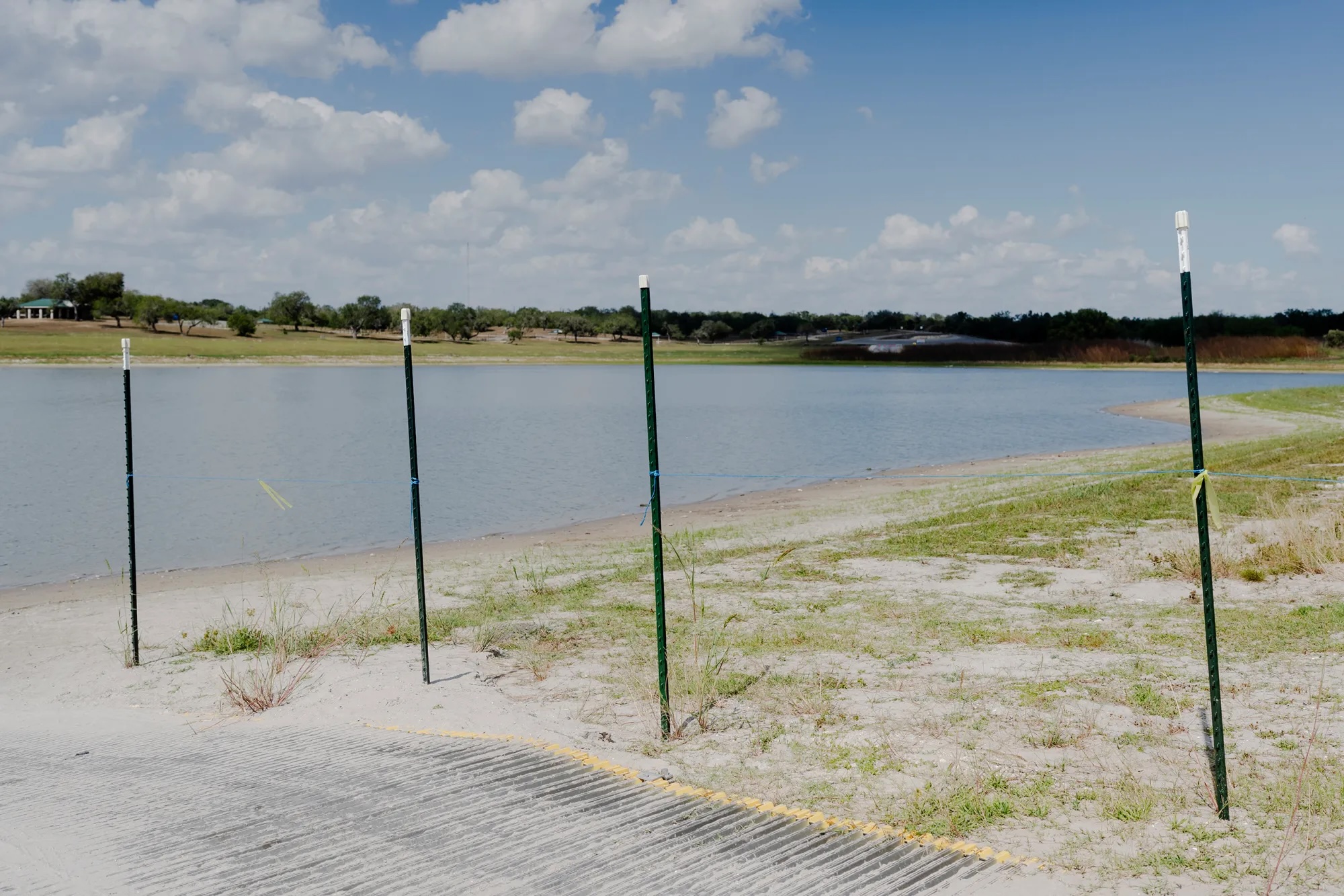
Photo: Corpus Christi Lake at 11.8% capacity seen from the portable boat ramp on October 20, 2025, the only 6 operational ramps in the state park. Brenda Bazán for The Texas Tribune